By Atty. Alvin Abenojar, LCB
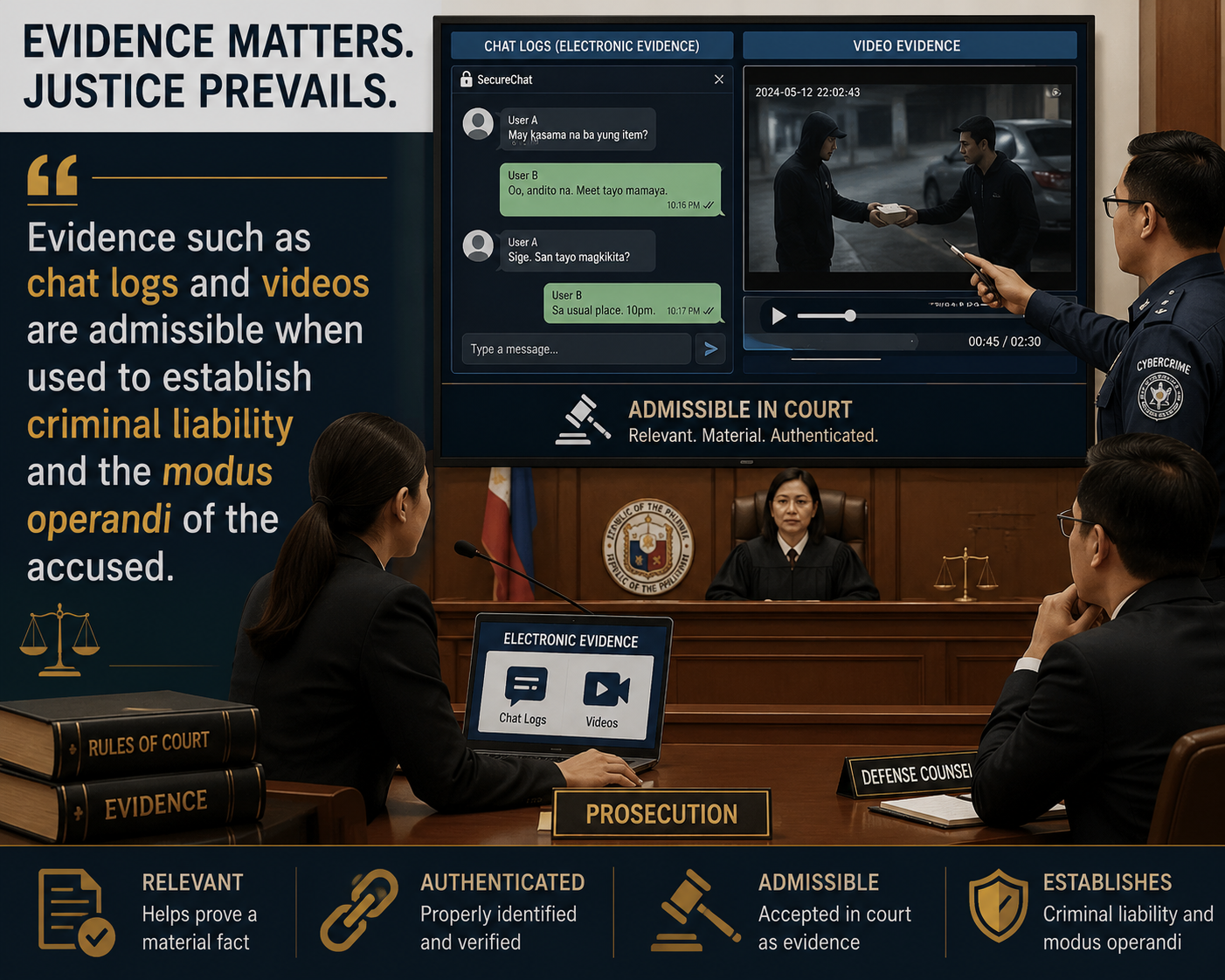
“Evidence such as chat logs and videos are admissible when used to establish criminal liability and the modus operandi of the accused.” This is one of the doctrines elucidated by the Court in People v. Rodriguez (G.R. No. 263603, October 2023). The Supreme Court likewise held that entrapment, as opposed to instigation, is a valid law-enforcement technique and does not bar prosecution or conviction. In cases of qualified trafficking in persons, the prosecution need not prove the victim’s consent or psychological trauma.
Guided by the foregoing polestars, the High Court indubitably convicted the accused Rodriguez of qualified trafficking in persons, imposed the highest penalty of life imprisonment, and ordered him to pay a fine, moral damages, and exemplary damages, with a total of 800,000.
The relevant facts of the case are that Rodriguez was charged with qualified trafficking for providing and transporting a minor, AAA263603, for prostitution, acting as a procurer for a male customer in exchange for money. The case stemmed from a tip by US ICE, leading to an online investigation and eventual entrapment operation by Philippine police, where Rodriguez offered minors for sexual exploitation via Facebook and Skype. On February 13, 2014, Rodriguez brought AAA263603, then 14 years old, to a hotel to meet a supposed foreign customer, unknown to him; the foreigner was actually a police officer, and Rodriguez received the marked money, and he was arrested. The prosecution presented evidence, including chat logs, videos, and testimonies from police officers and the minor, showing Rodriguez’s repeated involvement in online sexual exploitation of minors. On the other hand, Rodriguez denied the charges, claiming he only brought the minor to eat pizza, and argued that the evidence was inadmissible due to alleged illegal arrest, violation of privacy, and lack of proof of the transaction.
In consonance with his denial, Rodriguez argued that his arrest was illegal, claiming the operation was an instigation rather than an entrapment, making the evidence inadmissible. He also proffered that the chat logs and videos violated his constitutional right to privacy and the Anti-Wiretapping Law. He further contended that the prosecution failed to prove all elements of qualified trafficking, particularly the existence of a transaction and the victim’s psychological trauma.
However, the People, through the OSG, countered that the arrest was lawful, as it was made in flagrante delicto during a valid entrapment operation, thereby rendering the evidence admissible. They maintained that the chat logs and videos were properly authenticated, relevant to establishing Rodriguez’s intent and modus operandi, and did not violate privacy laws. The prosecution argued that all elements of qualified trafficking were proven, as Rodriguez’s actions and communications clearly showed the purpose of sexual exploitation of a minor.
The RTC and CA are in unison finding Rodriguez guilty of the crime charged.
Undaunted by the decision, he raised the case to the Supreme Court. The relevant portion of the case is herein provided. In summary, Rodriguez raises three main arguments against his conviction. First, his arrest was illegal because it was an instigation rather than an entrapment. Consequently, the pieces of evidence recovered from him are inadmissible in evidence. Second, the trial court erred in relying on the chat logs, as these are “extraneous evidence” and a violation of his constitutional right to privacy. Third, the prosecution failed to prove the elements of the crime of qualified trafficking since none of the prosecution’s witnesses had personal knowledge of the conversation between the CI and Rodriguez.
The ruling of the Court is astutely provided, hereunder.
The Court distinguished entrapment from instigation, finding that Rodriguez was predisposed to commit the crime, as shown by his prior conduct and communications. The police merely provided the opportunity for Rodriguez to commit the offense, and there was no evidence of inducement by law enforcement. The entrapment operation was valid, and thus, the arrest and subsequent search and seizure were lawful.
Pertinently, as to the second issue, the High Court held that the Data Privacy Act allows the processing of sensitive personal information for the determination of criminal liability and protection of lawful rights in court proceedings. The chat logs and videos were properly authenticated and used to establish Rodriguez’s modus operandi, not to prove the crime itself. The Anti-Wire Tapping Law was not violated, as the recordings were not of the nature contemplated by the law (i.e., tapping the main line of a telephone).
The High Court also noted that all elements of qualified trafficking in persons were proven beyond reasonable doubt. The Court found that Rodriguez’s acts of transporting and providing a minor for sexual exploitation were established by testimonial and documentary evidence. The minor’s consent or psychological trauma is not an element of the crime, and the prosecution sufficiently proved Rodriguez’s criminal intent and actions.
Hence, the High Court indubitably convicted Rodriguez of qualified trafficking in persons, imposed the highest penalty of life imprisonment, and ordered him to pay a fine, moral damages, and exemplary damages, for a total of 800,000.
OoO
- People vs. Rodriguez – 263603.pdf