By Atty. Alvin Abenojar, LCB
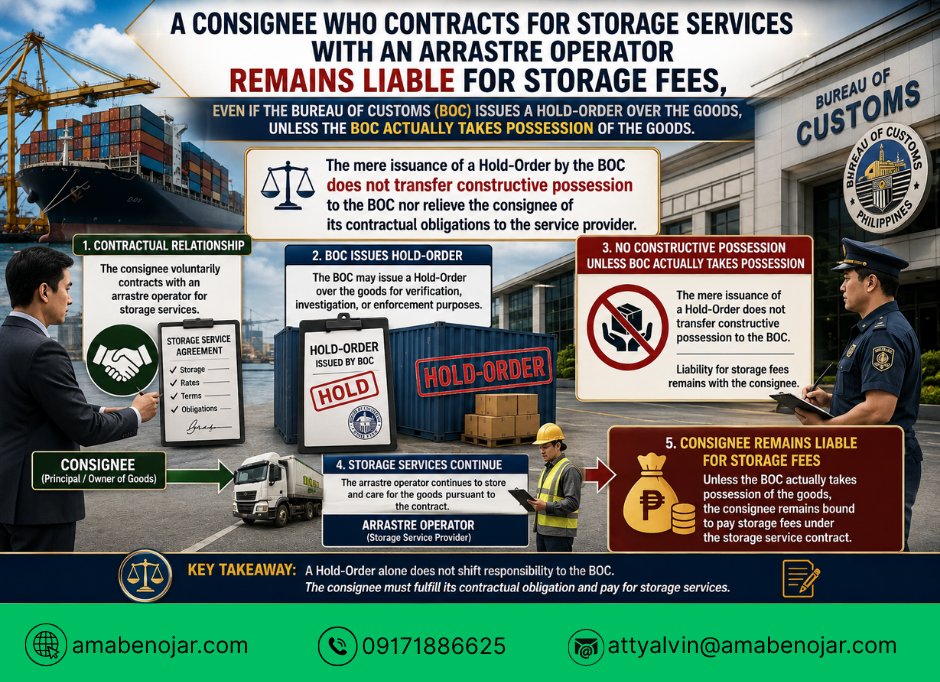
“A consignee who contracts for storage services with an arrastre operator remains liable for storage fees, even if the Bureau of Customs (BOC) issues a Hold-Order over the goods, unless the BOC actually takes possession of the goods. The mere issuance of a Hold-Order by the BOC does not transfer constructive possession to the BOC nor relieve the consignee of its contractual obligations to the service provider.” This is the Doctrine elucidated by the Highest Court in the case of Asian Terminal, Inc. vs. Padoson Stainless Steel Corporation.[1]
The facts of the case were laid out by the Court in this wise: Padoson Stainless Steel Corporation (Padoson) engaged Asian Terminals, Inc. (ATI) to provide arrastre, wharfage, and storage services for the former’s shipments of steel coils imported in October 2001, which remained in ATI’s custody until July 29, 2006. The Bureau of Customs (BOC) issued a Hold-Order on September 7, 2001, over the shipments due to Padoson’s tax liabilities, resulting in a pending customs case. ATI repeatedly demanded payment from Padoson for storage fees totaling P8,914,535.28, but Padoson did not pay, prompting ATI to file a complaint for sum of money and damages. Padoson countered that the shipments deteriorated while in ATI’s custody and that one coil was missing, claiming losses and attributing responsibility to ATI. The trial court and Court of Appeals (CA) both ruled that the BOC, not Padoson, was liable for the storage fees due to the Hold-Order, and dismissed both ATI’s claim and Padoson’s counterclaim.
The relevant issue of this case, the Court threshed out, is whether or not the BOC’s issuance of a Hold-Order transferred constructive possession and liability for storage fees from Padoson to the BOC. The Highest Court answered in the negative, emphasized that the lower courts misapplied the doctrine laid down in a seminal case of Subic Bay Metropolitan Authority v. Rodriguez,[2] clarifying that the BOC only acquires exclusive jurisdiction and actual possession for customs enforcement purposes, not for private contractual obligations, upon actual, not constructive possession. The Court proffered that the contract for storage services was between ATI and Padoson, and the BOC was not a party to this contract; thus, Padoson could not evade liability for storage fees by invoking the BOC’s Hold-Order. The BOC’s Hold-Order was related to tax enforcement and did not affect the contractual relationship or obligations between ATI and Padoson. The Court found that the BOC was not an indispensable party to the collection suit, as complete relief could be granted between ATI and Padoson without the BOC’s participation.
The Supreme Court granted ATI’s petition, reversed and set aside the CA and RTC decisions, and ordered Padoson to pay ATI the amount of P8,914,535.28, plus interest at 12% per annum from August 4, 2006 to June 30, 2013, and 6% per annum from July 1, 2013 until full satisfaction. Claims for exemplary damages and attorney’s fees by ATI were denied by the Court.
[1] G.R. No. 211876, June 25, 2018
[2] G.R. No. 160270, April 23, 2010