By Atty. Alvin Abenojar, LCB
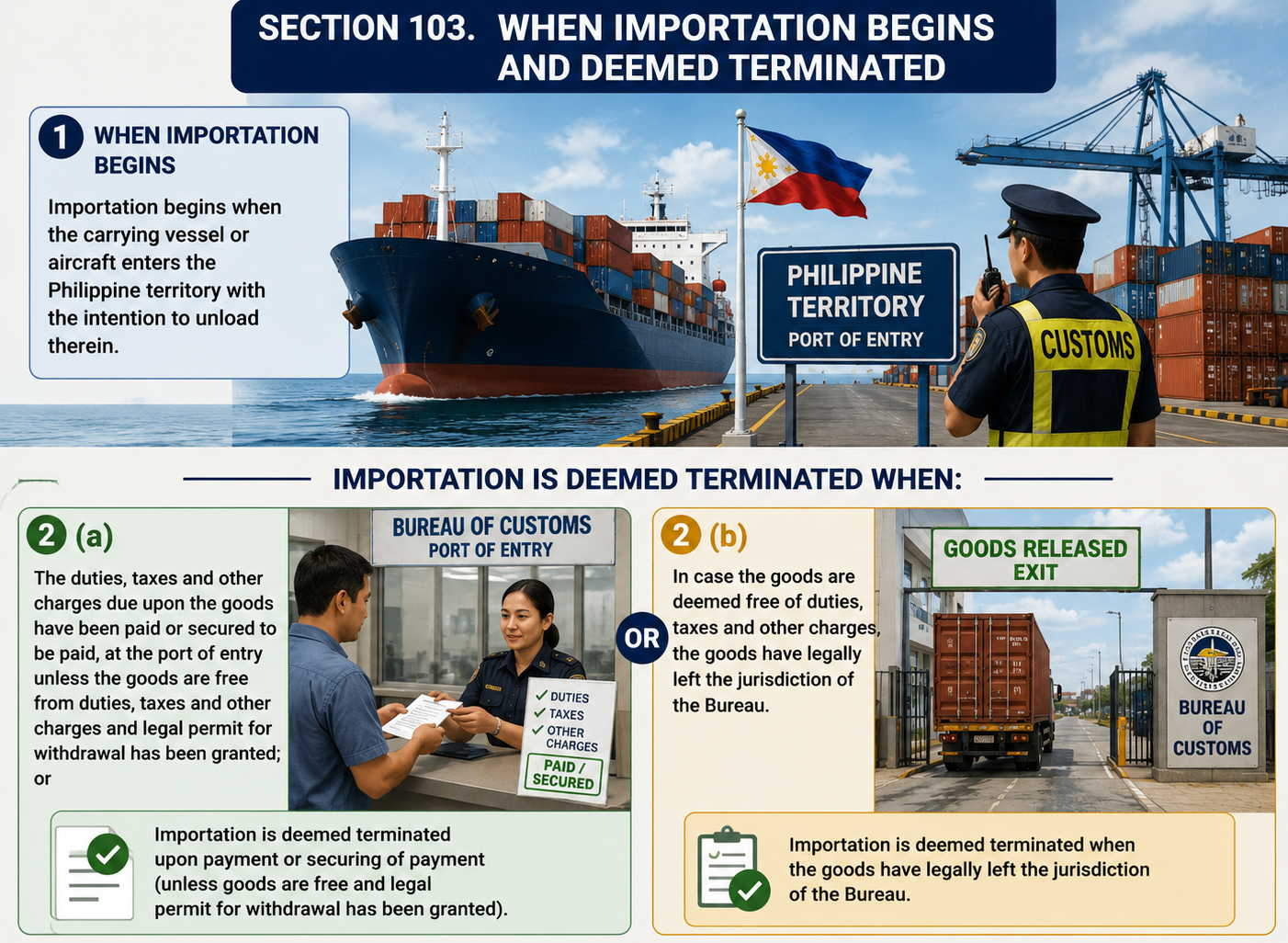
SECTION 103. WHEN IMPORTATION BEGINS AND DEEMED TERMINATED. – Importation begins when the carrying vessel or aircraft enters the Philippine territory with the intention to unload therein. Importation is deemed terminated when:
(a) The duties, taxes and other charges due upon the goods have been paid or secured to be paid, at the port of entry unless the goods are free from duties, taxes and other charges and legal permit for withdrawal has been granted: or
(b) In case the goods are deemed free of duties, taxes and other charges, the goods have legally left the jurisdiction of the Bureau.
NOTES & CASES:
Section 103 of the Customs Modernization and Tariff Act (CMTA) fixes when importation begins and termination points of importation for customs purposes, like when the Bureau of Customs (BOC) acquires jurisdiction over the imported goods, and when that jurisdiction ends. It matters for the assessment and collection of duties and taxes, enforcement actions such as seizure and forfeiture, and the release of goods.
When importation begins
Importation begins when a vessel or aircraft enters Philippine territory with the intent to unload the goods here. The critical factors are physical entry and intent to unload; it is not necessary for the goods to have already been unloaded. Intent is often inferred from documents such as manifests, charter terms, and voyage patterns, as well as from the surrounding circumstances. Jurisprudence confirms that importation begins upon entry with the intent to unload, which can be deduced from conduct and the surrounding circumstances.
When importation is deemed terminated
Termination is the legal endpoint of the importation process when BOC’s customs control over the goods as imported goods is supposed to end under the CMTA rule. There are two tracks, depending on whether the goods are dutiable/taxable or free.
A. For dutiable/taxable goods (ordinary rule)
Importation is terminated when both of these are satisfied:
- Duties, taxes, and other charges have been paid or secured to be paid at the port of entry; and
- The legal permit for withdrawal has been granted.
Thus, payment alone is not enough unless accompanied by the legal permit for withdrawal/release. This is emphasized in the case of Commissioner of Customs vs. Milwaukee Industries Corporation[1], where the law applies the equivalent provision: when imported goods are transferred under continuous customs supervision and have not yet been released by customs authorities, legal and physical custody remains with the Bureau of Customs. Payment of duties and taxes, coupled with an order of release from the Commissioner, constitutes legal termination of importation; hence, the BOC’s continuing control/custody, such as the presence of guards, no release indicates importation has not legally terminated despite payment.
What “secured to be paid” generally means in customs practice: payment is guaranteed through an allowable security, for example, a bond or undertaking, so the government’s collection is protected even before final settlement.
B. For goods free from duties/taxes/charges
If the goods are deemed free of duties, taxes, and charges, importation is terminated when the goods have legally left the jurisdiction of the Bureau.
This addresses situations where there is no duty/tax collection to mark the endpoint; instead, the endpoint is when the goods are no longer within BOC’s lawful customs control, having exited BOC’s jurisdiction in a manner recognized by law/procedure.
Why Section 103 matters?
Until importation is terminated, the goods remain under BOC jurisdiction and control, and customs enforcement powers remain in play. This is consistent with the doctrine that, so long as importation is not completed or terminated, the imported item remains under BOC jurisdiction. In Secretary of Finance v. Oro Maura Shipping Lines,[2] it was elucidated by the Court that the final assessment of customs duties may be set aside and re-assessment ordered by the Secretary of Finance or the Commissioner of Customs when there is evidence of fraud, misdeclaration, or undervaluation, even if more than one year has passed since payment. The government is not estopped by the errors or omissions of its agents in the collection of taxes, and a tax lien attaches to imported goods regardless of changes in ownership until the correct duties and taxes are fully paid
The word “begins” rule also supports enforcement even before unloading if the circumstances show intent to unload in the Philippines. In a seminal case, Gold Mark (2021), Justice Lazaro-Javier passionately held that importation commences when the carrying vessel or aircraft enters Philippine territory and unloads, or intends to unload, the article or goods in the Philippines. Thus, mere intent to unload into the Philippines consummates importation. Intent, being a state of mind, is rarely susceptible of direct proof, but must ordinarily be inferred from the facts, and therefore, can only be proved by unguarded expressions, conduct, and attendant circumstances.[3]
[1] Commissioner of Customs vs. Milwaukee Industries Corp., 487 Phil. 117 (December 2004)
[2] July 15, 2009, G.R. No. 156946
[3] June 30, 2021, G.R. No. 208318