By Atty. Alvin Abenojar, CB
SECTION 407. GOODS DECLARATION AND PERIOD OF FILING. – As far as practicable, the format of the goods declaration shall conform with international standards. The data required in the goods declaration shall be limited to such particulars that are deemed necessary for the assessment and collection of duties and taxes, the compilation of statistics and compliance with this Act. The Bureau shall require the electronic lodgement of the goods declaration.
The Bureau shall only require supporting documents necessary for customs control to ensure that all requirements of the law have been complied with. Translation of supporting documents shall not be required except when necessary.
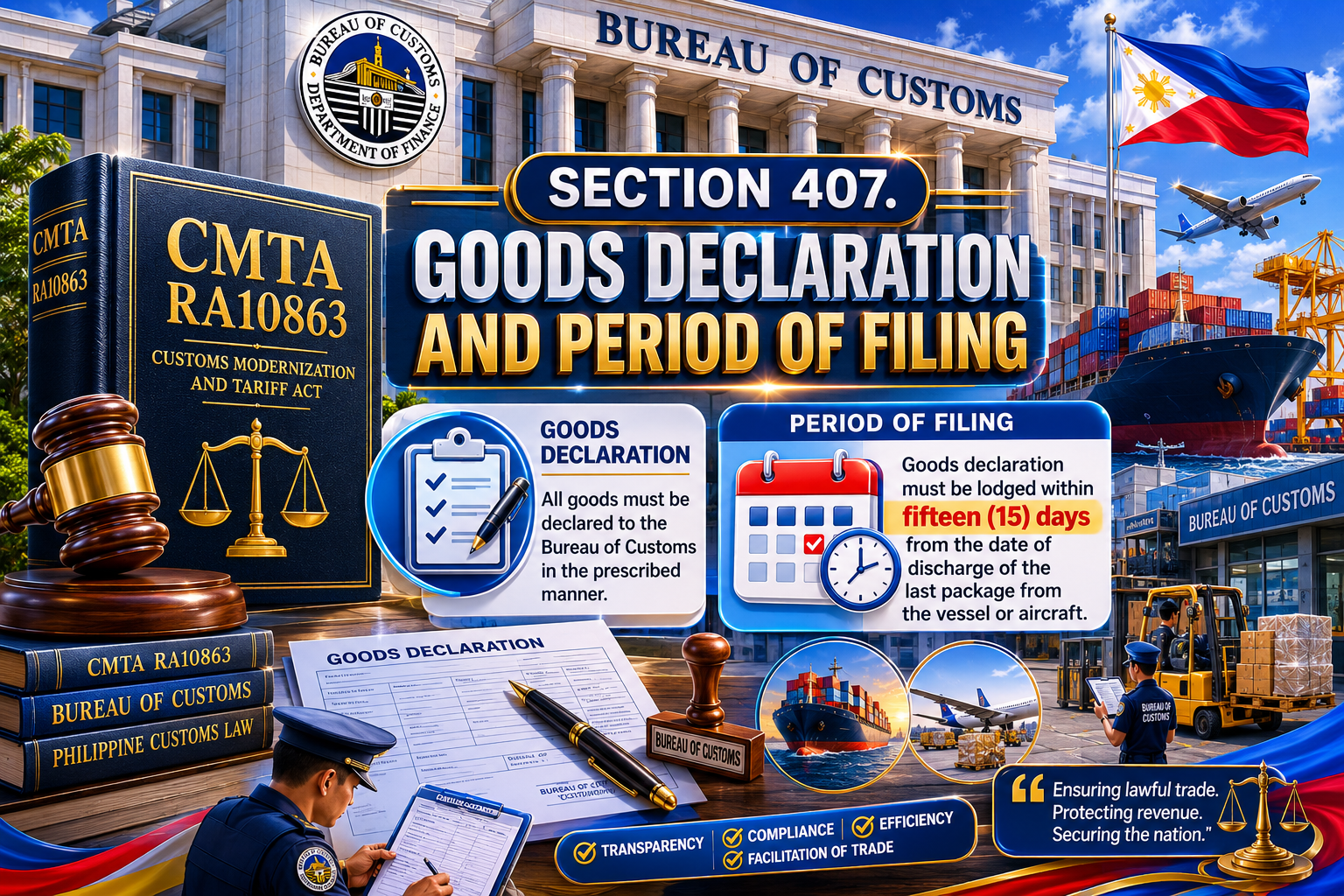
Goods declaration must be lodged within fifteen (15) days from the date of discharge of the last package from the vessel or aircraft. The period to file the goods declaration may, upon request, be extended on valid grounds for another fifteen (15) days: Provided, That the request is made before the expiration of the original period within which to file the goods declaration: Provided, however, That the period of the lodgement of the goods declaration maybe adjusted by the Commissioner.
NOTES & CASES:
Section 407 of the Customs Modernization and Tariff Act (CMTA) explains the details of how, what, and when to file a goods declaration, the essential document used to determine duties, taxes, and ensure compliance. It also marks an exciting move towards paperless, electronically lodged declarations, streamlining the process and making it more convenient.
The goods declaration format and data should follow international standards to ensure everything works smoothly across borders. It’s helpful if the Bureau of Customs (BOC) only asks for the information necessary for duties, taxes, statistics, and compliance with the CMTA. This way, the process stays simple and efficient for everyone involved. A Goods Declaration refers to a statement made in the manner prescribed by the Bureau and other appropriate agencies, by which the persons concerned indicate the procedure to be observed in the application for the entry or admission of imported goods, and the particulars of which the customs administration shall require.[1]
How it must be submitted: electronic lodgement
Electronic lodgement now makes the process simpler and more efficient for everyone. Under Section 407, the BOC is empowered to guide the electronic submission of goods declarations through the customs system, supporting the CMTA’s push towards modernization. CMO 40-2008 emphasizes the importance of electronically lodging goods declarations through Value-Added Service Providers (VASPs) and imposes administrative sanctions on those who do not comply. This approach helps improve the monitoring of imported shipments and ensures the accuracy of the data collected.[2]
Jurisprudence clarifies that under the CMTA, “lodgement” and “filing” mean the same declaration, with the main difference being the mode of submission, either electronically or manually. In the case of Chamber of Customs Brokers, Inc. (CCBI) v. Commissioner of Customs,[3] the Court explained this clearly. The Court pointed out that an examination of this provision, referring to Sec. 407 of RA10863 (emphasized mine), shows there is no real distinction between “lodgement” and “filing” of a goods declaration; the only difference is how they are submitted. “Lodgement” refers to electronic submission, while “filing” refers to manual submission. Nonetheless, both terms relate to the same goods declaration.
Supporting and Translation documents: when are they required?
Only the supporting documents necessary for “customs control” are required. The BOC may request additional attachments solely to verify that legal requirements, such as valuation, classification, origin, and permits for regulated goods, are appropriately fulfilled. Translations cannot be mandated unless deemed essential. This measure safeguards traders from incurring unnecessary compliance costs.
Period of lodgement
The period of lodgment is 15 days from the date of discharge of the last package from the vessel or aircraft; this is the statutory reference point. One extension is permissible, upon a valid request, for an additional 15 days, provided the request is made prior to the expiration of the initial 15-day period.
Commissioner’s power to adjust the lodgement period
The last provision authorizes the Commissioner of Customs to adjust, either to shorten or modify, the lodgement period set by the statute. This is exactly what the BOC did by administrative issuances, under CMO 27-2019, and reiterated for strict implementation in OCOM Memo 35-2020, the period to lodge was shortened to 7 days from discharge of the last package. In keeping with the Bureau’s mandate to facilitate trade in goods, optimize revenue generation, further ease port congestion, streamline processes, and protect the interests of its stakeholders, there is a need to shorten the lodgment period for goods declarations and the payment of duties and taxes. Accordingly, the 15-day period to lodge a goods declaration is hereby shortened to seven (7) days from the date of discharge of the last package from the vessel or aircraft.[4]
Practical takeaway
Section 407 is all about making trade smoother and more efficient. It encourages electronic submission and keeps data and document requests to only what is truly necessary. The provision also sets a clear deadline for lodgement, linked to the discharge of the last package. Extensions are allowed but controlled, and the Commissioner has the flexibility to adjust the timeline if needed, ensuring a balanced and practical approach. Additionally, it explains the trigger point for implied abandonment according to Section 1129(b) of the CMTA. Simply put, if you miss the Section 407 filing period after receiving notice, the shipment is automatically deemed abandoned under the law. This is subject to the reclaim window and disposal rules outlined in Section 1130 and CAO 17-2019.
The statutory connection between Section 407 and Section 1129 (b) regarding implied abandonment highlights an important legal relationship.
Section 1129(b) expressly provides that imported goods are deemed abandoned when the owner/importer/consignee/interested party, after due notice, fails to file the goods declaration within the prescribed period provided in Section 407. It also clarifies that “goods declaration” includes a provisional or incomplete goods declaration recognized under Section 403.
Key point:
The CMTA makes the consequence (abandonment) depend on two elements:
- Due notice, and
- Failure to lodge/file within the period provided by Section 407.
What “due notice” means under the CMTA and implementing rules
The CMTA encourages the District Collector to promptly post a list of all discharged packages and their consignees, whether electronic or in personal service, or to notify the consignee within five (5) days of discharge. This helps fulfill the “due notice” requirement outlined in Section 1129(b).
CAO 17-2019 stipulates that a Notice to Lodge or File Goods Declaration must be issued within five (5) calendar days from the date of discharge of the last package. Furthermore, the District Collector is required to post the list electronically or physically, or to send notice accordingly.
Recent practices by BOC have further standardized the notification process by mandating the daily publication of a “Notice to Lodge Goods Declaration” on the website, explicitly cautioning that failure to lodge within the period under Section 407 will be deemed as implied abandonment.[5]
The deadline that matters: “date of discharge of the last package,” not arrival
The pivotal point for the Section 407 period is the date of discharge of the last package from the vessel or aircraft. This is significant in abandonment disputes because parties occasionally calculate from “arrival” rather than “discharge.”
The Supreme Court in the case of DOJ Secretary De Lima vs. Cabanes & Uy[6] emphasized that the reckoning point is the date of the discharge of the last package. The Single Administrative Declarations submitted by the prosecution do not show the date of the discharge of the last package, which is the reckoning period for abandonment. Without proof of the date of discharge of the last package, abandonment cannot be validly inferred just from the date of arrival.
Implementing details on extensions, downtime, and “provisional” filings (to avoid abandonment)
CAO 17-2019 recognizes the statutory one-time extension of 15 days, on valid grounds, requested before the original period lapses, enumerates acceptable grounds such as fraud, accident, mistake, excusable negligence, force majeure, certified technical issues, and analogous circumstances, and bars further extensions.[7]
CAO 17-2019 also establishes a protective regulation; if the goods declaration has already been recorded or stored with the VASP but cannot be successfully registered due to system downtime, slowdown, or no response on the final day, the goods shall not be considered abandoned.
Separately, BOC issuances have reminded stakeholders that, in cases where complete information or documents are unavailable, a provisional goods declaration, as acknowledged in the CMTA[8], may be submitted to prevent the shipment from being marked or declared as abandoned.
Legal consequences once implied abandonment occurs, and the potential window for “reclaim”.
Once implied abandonment attaches under Section 1129(b), the treatment is governed by Section 1130. If the BOC has not yet disposed of the impliedly abandoned goods, the owner/importer may reclaim within 30 days after the lapse of the period to file the declaration, provided all legal requirements are complied with, and duties/taxes/charges and related expenses are paid.
[1] Sec. 102 (y)
[2] CMO 40-2028 (1.1 & 1.2) in relation to CAO 8-2008
[3] G.R. No. 256907, February 20, 2023
[4] CMO 27-2019, Numbers 2 & 4
[5] AOCG Memo 218-2025, October 23, 2025
[6] G.R. Nos. 219295-96 & 229705, July 2021
[7] CAO 17-2019, Sec. 4.2.1
[8] Section 403