By Atty. Alvin Abenojar, LCB
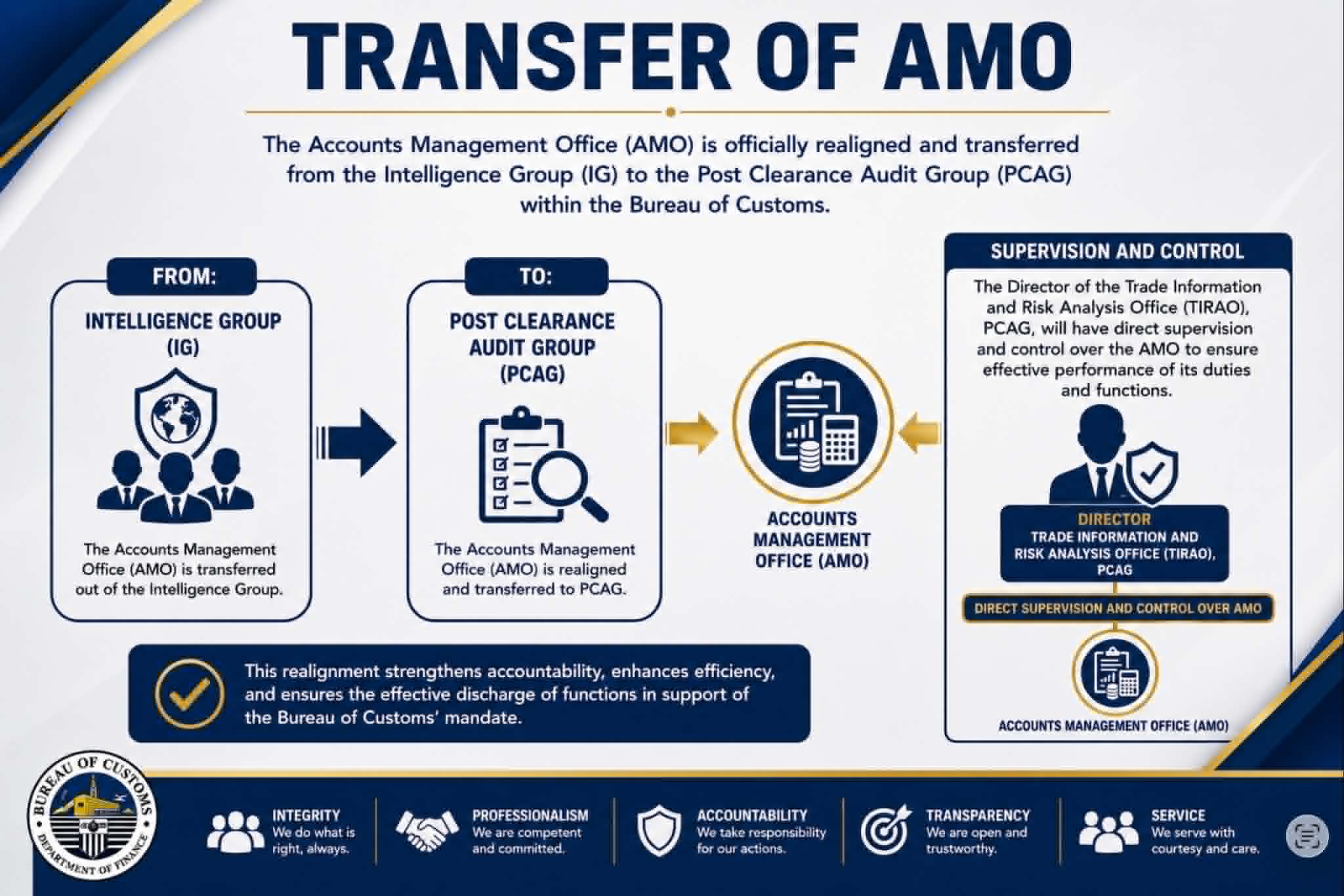
Bureau of Customs Commissioner Ariel F. Nepomuceno issued last June 2, 2026, Customs Memorandum Order (CMO) 10-2026, effectively transferring the Account Management Office (AMO) from the Intelligence Group to the Post Clearance Audit Group, directly under the supervision and control of the Director of the Trade Information and Risk Analysis Office (TIRAO).
The relevant portion of the CMO provides that, to ensure the AMO effectively performs its duties and functions, the Director, Trade Information and Risk Analysis Office (TIRAO), PCAG, shall have direct supervision and control over the AMO. The Director, TIRAO, and the Chief, AMO, are hereby directed to undertake measures to prevent disruption of the operations of the AMO with the least effect on service to the public as a result of the transfer. Further, the conduct of risk-based evaluation and account management activities shall be aligned with the PCAG’s established trade information, risk assessment, and profiling parameters to ensure seamless processing and approval of registration, renewal, suspension, cancellation, and related account actions.[1] Guided by the foregoing polestars, it is the author’s humble submission that the transfer of the AMO to PCAG is appropriate, given that PCAG is the central repository of information on stakeholders with transactions with the Bureau of Customs.
In Section 2 of CMO 32-2017[2] underscores the functions of PCAG, shall conduct, within three (3) years from date of final payment of duties and taxes or customs clearance, an audit examination, inspection, verification, and investigation of records pertaining to any goods declaration, which shall include statements, declarations, documents, and electronically generated or machine readable data, for the purpose of ascertaining the correctness of the goods declaration and determining the liability of the importer for duties, taxes and other charges, including any fine or penalty.
The PCAG is headed by an Assistant Commissioner (SG 28) of the BOC, duly appointed by the President of the Philippines upon recommendation of the Commissioner of Customs through the Secretary of Finance. The Assistant Commissioner shall exercise direct supervision and control in the management of the following operating units of PCAG, the Trade Information and Risk Analysis Office (TIRAO), to be headed by a Director II (SG 26) which is supported by two divisions the Trade Information Analysis Division I and II); and the Compliance Assessment Office (CAO) to be headed by a Director II (SG 26) and supported by five divisions (Audit Divisions I-V)[3]
Preveniently, it is noteworthy to mention CMO 04-2014[4], issued last February 21, 2014, by Commissioner John P. Sevilla, Customs Memorandum Order 04-2014 was issued to implement DOF Department Order No. 12-2014, addressing the need for a unified, simplified, and stricter accreditation process for importers and customs brokers transacting with the Bureau of Customs (BOC). The Order aims to enhance transparency, accountability, and risk management in customs operations by standardizing requirements and procedures. This shifted the previous framework by centralizing accreditation, introducing risk profiling, and linking accreditation to compliance with both BOC and BIR requirements. One of the key provisions falls under Section 3.5 [Suspension, Revocation or Cancellation], which enumerates grounds for suspension, revocation, or cancellation of accreditation, including violations of sworn undertakings, submission of false information, and non-reporting of customs fraud. OoO
[1] 2nd & 3rd paragraph CMO 10-2026 dated June 2, 2026
[2] REACTIVATION OF THE POST CLEARANCE AUDIT GROUP
[3] Section 1, CMO 32-2017
[4] Policies, guidelines and procedures for the Accreditation of Importers and Customs Brokers with the Bureau of Customs (BOC) pursuant to DOF Department Order No. 12 – 2014