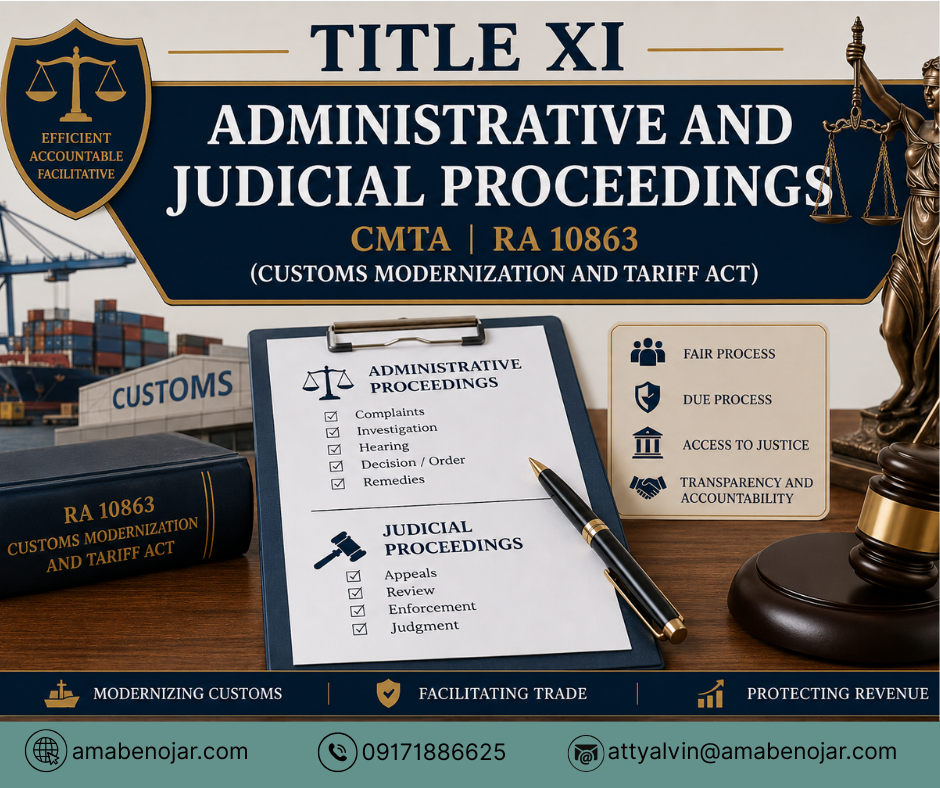
Section 1111 (Chapter 3, Alert Orders) of the Customs Modernization and Tariff Act explains when the Bureau of Customs (BOC) may “hold” a shipment for inspection, and the strict limits on doing so. It was designed to prevent arbitrary cargo holds and require specific, documented grounds.
What an “Alert Order” is, and what it does
It shall refer to a written Order issued by the Commissioner, District Collector, or other customs officers authorized in writing by the Commissioner after the Lodgement of Goods Declaration and before their actual release from customs custody, on the basis of derogatory information regarding possible non-compliance with the CMTA and other laws, rules, and regulations enforced by Customs.[1]
Mandatory timeline after inspection
Following the inspection, the “alerting officer’ is required to act promptly within 48 hours from the time of inspection, or within 24 hours in the case of perishable goods. The officer must recommend either the continuation of the processing of the import declaration or the issuance of a Warrant of Seizure and Detention (WSD) if a discrepancy exists between the declared information and the findings.
The meaning of “Derogatory information” must be specific
The AO must be based on derogatory information that identifies the violation and includes the necessary specifics; it refers to any information indicating that a certain shipment is at high risk of violating the provisions of the CMTA and related laws. Said information shall indicate the violation and other specifics thereof.[2] The law expressly states that the following are NOT “derogatory information,” so they cannot justify issuing an AO[3]:
- Undervaluation (general allegation only);
- Misclassification (general allegation, without stating the proper tariff heading and duty);
- Over-quantity (general allegation, without stating the source of the information);
- Misdeclaration (general allegation, without stating the suspected actual contents); and
- Importations “contrary to law” (general allegation, without stating the specific law/rule violated).
This is reflected in the implementation of CAO 07-2019, which emphasizes that an AO should be based on clear, specific written derogatory information rather than vague accusations. Moreover, when it concerns undervaluation, no alert order should be issued solely based on allegations of undervaluation unless it is proven that the undervaluation resulted from submitting forged or spurious invoices or other fraudulent documents to customs.[4]
When can an Alert Order be issued?
An Alert Order may be issued only after the goods declaration is lodged and before the goods are released from customs custody. Similarly, the law is categorical that processing of the goods declaration cannot be suspended except through a valid AO issued by an authorized officer.
Who pays for the inspection?
As a rule, the BOC bears the cost of physical inspection. However, the owner must reimburse that cost before release if the inspection results in either the assessment of additional duties or taxes or the issuance of a WSD.
Internal controls: notice to Commissioner, tracking, clearing house
To reduce abuse and improve oversight, the law requires the following:
- The Commissioner must be notified of the alerting officer’s recommendation within 24 hours from AO issuance;
- AOs must be dated and given a unique reference number for monitoring by the Commissioner and DOF; and
- A central clearing house must be created, with quarterly reports on AO status.
Section 1112: Perishable goods
If the goods are perishable, the BOC must attach a certificate indicating the perishability of the goods, and the post-inspection recommendation deadline is reduced to 24 hours instead of 48 hours for general cargoes. This facilitates the expedited processing and specialized handling requirements for perishable goods.
[1] CA0 07-2019, Sec. 3.1
[2] CA0 07-2019, Sec. 3.4
[3] CA0 07-2019, Sec. 6.1.3
[4] 3rd paragraph, Section 1111, CMTA