
By: Atty. Alvin Abenojar, LCB
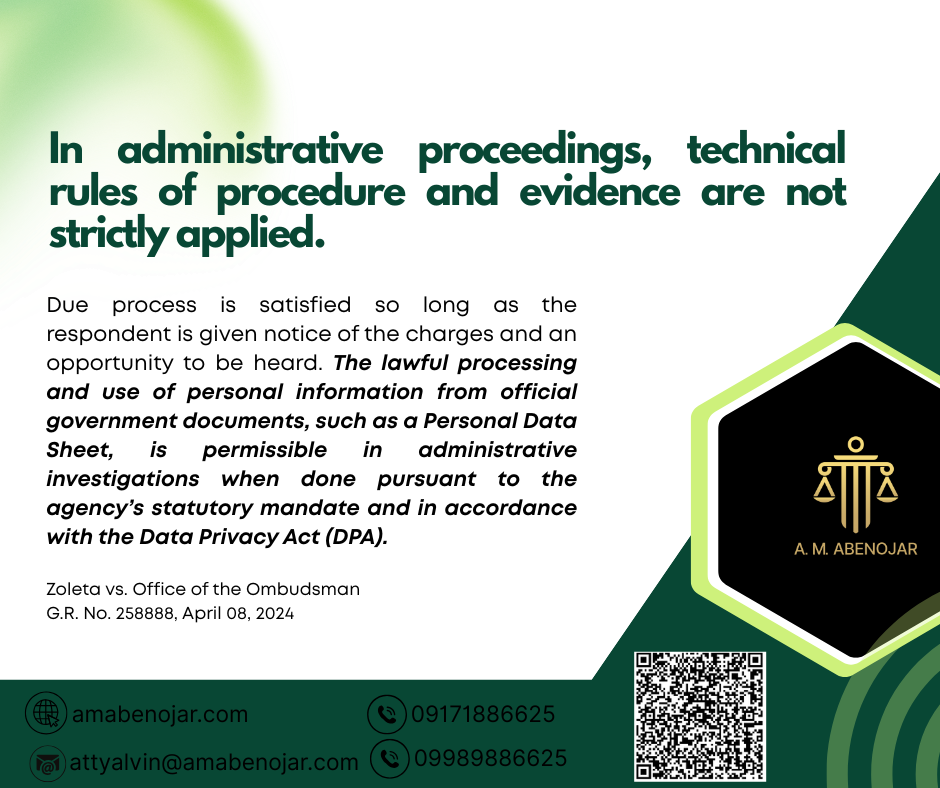
“IN ADMINISTRATIVE PROCEEDINGS, TECHNICAL RULES OF PROCEDURE AND EVIDENCE ARE NOT STRICTLY APPLIED, AND DUE PROCESS IS SATISFIED SO LONG AS THE RESPONDENT IS GIVEN NOTICE OF THE CHARGES AND AN OPPORTUNITY TO BE HEARD. The lawful processing and use of personal information from official government documents, such as a Personal Data Sheet, is permissible in administrative investigations when done pursuant to the agency’s statutory mandate and in accordance with the Data Privacy Act (DPA).”
The doctrine cited is culled from the case of Zoleta vs. OMB, G.R. No. 258888, dated April 8, 2024. The facts of the case are cited as follows: Nicolas, Jr., an officer of the Office of the Ombudsman (OMB), was arrested in an entrapment operation for extortion and subsequently executed an affidavit implicating Zoleta, a former Assistant Ombudsman, in case-fixing activities in exchange for money. On August 4, 2017, Oguis of the Internal Affairs Board-Investigating Staff (IAB-IS) filed a complaint against Zoleta for Serious Dishonesty, Grave Misconduct, and Conduct Prejudicial to the Best Interest of the Service, citing violations of the RRACCS and R.A. No. 6713. Zoleta was preventively suspended, and instead of filing a counter-affidavit, submitted a Manifestation questioning the sufficiency and admissibility of the complaint and evidence.
Zoleta argued based on two grounds. He argued that his right to due process was violated because he was not allowed to cross-examine the complainant’s representative and witness, and that the evidence against him was inadmissible, and he claimed that the use of his mobile phone number from his 2011 Personal Data Sheet was protected under the DPA and could not be used to identify him in the alleged case-fixing scheme.
On the other hand, the OMB maintained that Zoleta was afforded due process, as he was notified of the charges and given opportunities to respond and present his defense. It further argued that technical rules of evidence do not strictly apply in administrative proceedings, and that the evidence, including affidavits and text messages, was sufficient to establish Zoleta’s liability. The OMB asserted that the use of Zoleta’s mobile number from his PDS was lawful and necessary for the administrative investigation, and that the dismissal of the related criminal case did not preclude administrative liability.
Thus, OMB found Zoleta guilty and imposed the penalty of dismissal, which was affirmed by the Court of Appeals (CA), holding that due process was observed and the evidence was sufficient.
Zoleta argued before the Supreme Court that his rights to due process and privacy were violated, and that the evidence against him was inadmissible and insufficient.
The ruling of the Court is elucidated in this wise: The Court held that due process in administrative cases requires only that the respondent be notified of the charges and given an opportunity to be heard, which Zoleta was afforded. He was able to submit a Manifestation, a Position Paper, and a motion for reconsideration, and was apprised of the evidence against him. The right to cross-examine is not indispensable in administrative proceedings, especially when the rules do not require a trial-type hearing and the case can be resolved on affidavits and documentary evidence.
The Court found that the affidavits, text messages, and corroborating documents provided substantial evidence of Zoleta’s involvement in case-fixing and receipt of bribes. The technical rules of evidence, including authentication of electronic evidence, are not strictly applied in administrative cases. The use of Zoleta’s mobile number from his PDS was lawful, as it was processed by the OMB in accordance with its mandate and the DPA, and was necessary to establish his identity in the investigation.
The Supreme Court denied Zoleta’s Petition for Review on Certiorari, affirming the decisions of the OMB and the CA that found him administratively liable for Grave Misconduct, Serious Dishonesty, and Conduct Prejudicial to the Best Interest of the Service, and upholding the penalty of dismissal from government service with all its accessory penalties.
Text of the decision, click here: E-Library – Information At Your Fingertips: Printer Friendly